
The AIM Methodology and The Presence Effect by Julie Jones
The AIM Methodology is a leadership and people-skills framework created by Julie Jones, built on three pillars: Attitude (the mindset you bring), Image (what people see before you speak), and Self-Management (leading yourself first). It is the framework behind her book The Presence Effect. The third pillar carries more weight than most people expect: TalentSmart's research found that emotional intelligence explains 58% of success in all types of jobs.
AIM is taught as a set of learnable behaviors rather than a personality type, which means it works for the quiet expert as well as the natural extrovert. Julie Jones teaches it to leaders and teams across Dallas-Fort Worth in person, and nationwide as a keynote and a corporate workshop.
TRUSTED BY
American Airlines | Frost Bank | JW Marriott | HPE | Bank of America | Grant Thornton | SMU

Why I built AIM
I spent fifteen years in education, then my husband and I built a plumbing company from a Jeep and a home office into a seven-figure business and sold it. In both worlds I watched the same thing happen. People who were brilliant at the work struggled the moment they had to lead the work.
The advice they got was never useful. Be more confident. Have more presence. Own the room. Nobody could tell them what to actually do differently on Monday morning.
So I broke it into three things a person can practice. What you bring into the room. What the room sees before you open your mouth. And what you do with yourself when it gets hard. Attitude, Image, Self-Management. That is AIM, and it is the whole framework.
3 Pillars of the AIM Methodology
The AIM Methodology breaks executive presence into three skills that can be understood, practiced, and strengthened. Attitude shapes the mindset you bring. Image influences what people see before you speak. Self-Management determines how effectively you lead yourself before leading others.
Attitude - the mindset you bring.
Attitude is the pillar people underestimate, because it sounds soft until you watch it decide a meeting. The mood you carry into a room arrives before your argument does, and your team reads it in the first few seconds. If you walk in braced for a fight, you will get one.
Attitude in AIM is not forced positivity. It is deciding, on purpose, what you are bringing into a room before you walk into it, and noticing when the day has decided for you. Leaders who do this well are not in a better mood than everyone else. They are simply not handing their mood to the room.
The practical work here is preparation and recovery. How you set yourself before a hard conversation, and how you reset after one so the next person does not inherit it.
Image - what people see before you speak.
Image is not a dress code. It is every signal you send before you have said a word: how you carry yourself, how you enter, how you listen, what your face does while somebody else is talking, and yes, how you present yourself physically.
People decide whether to trust you long before they evaluate what you said. That is not fair and it is not going away. The good news is that every one of those signals is learnable, and most leaders only need to fix two or three of them.
This is the pillar where technical experts gain the most ground fastest. Their competence is already real. Image is what lets a room see it.
Self Management - leading yourself first.
Self-Management is the pillar that holds the other two up. You cannot decide your attitude or control your signals if you cannot manage yourself when you are tired, frustrated, or being challenged in front of your team.
This covers the unglamorous things: how you handle criticism, how you keep your commitments, what you do with silence, how you respond when someone is wrong in a meeting. It is the difference between a leader people are careful around and a leader people are honest with.
Nobody follows a person they have to manage. Self-Management is where presence stops being a performance and starts being reliable.
THE BOOK
The Presence Effect - the book behind the framework
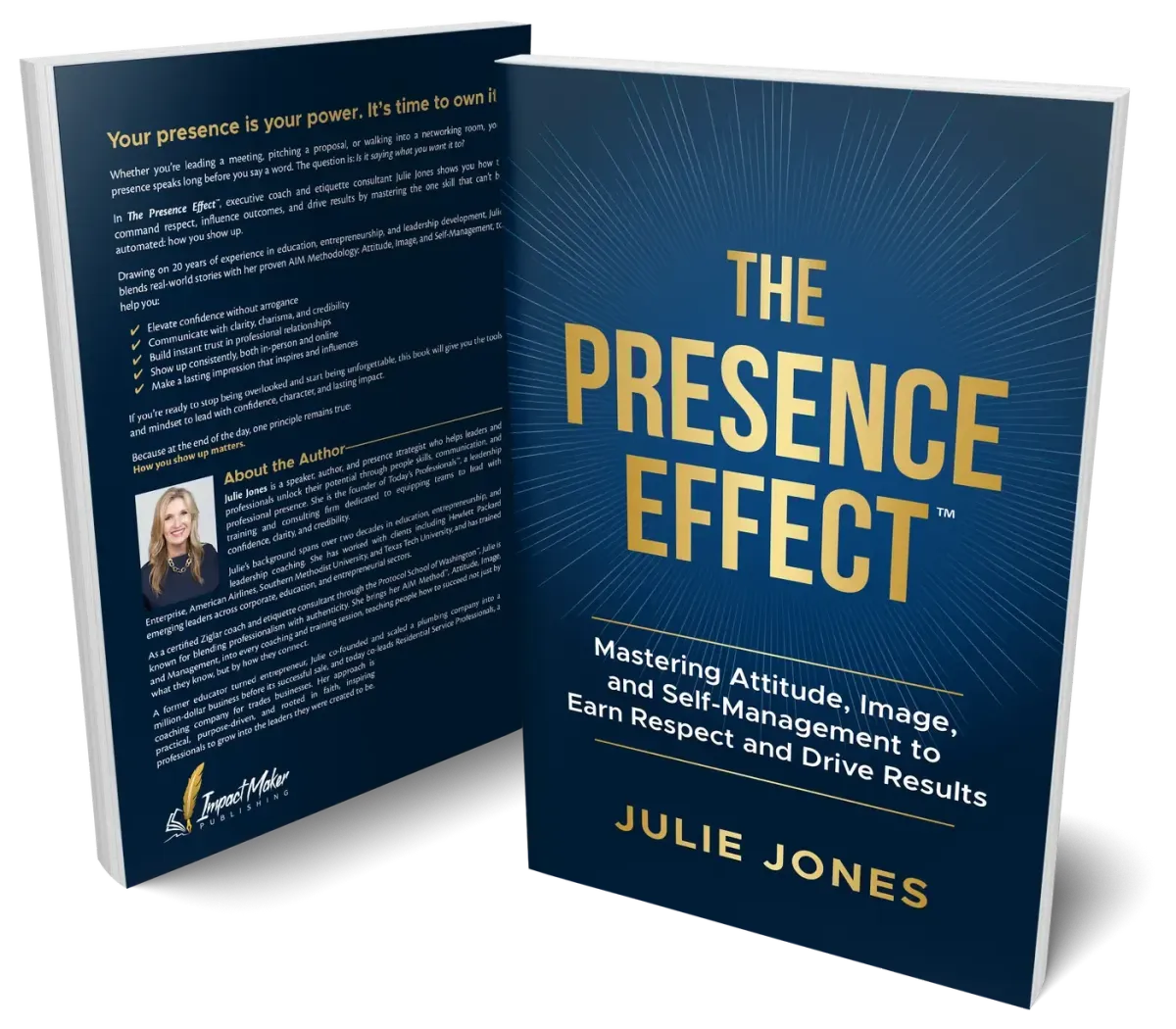
How you show up matters.
The Presence Effect is Julie Jones's book on how presence actually works, and it is where the AIM Methodology is laid out in full. It is written for the person who was promoted for being good at the job and then discovered that leading the job is a different skill entirely.
The book takes each pillar in turn and turns it into something you can practice this week rather than something you either have or you don't. It is for new managers, for technical experts stepping into leadership, for client-facing teams, and for anybody who has been told to have more presence without being told what that means.
Published by Impact Maker Publishing.
Bringing the book to your team pairs naturally with a live session. Volume book orders and a workshop or keynote are usually booked together.
How AIM is taught
AIM is not sold as an online course. It is taught live, in three formats.
KEYNOTE
As a keynote, it is Julie's signature talk and an audience walks out with the three pillars and something to do with them on Monday.
WORKSHOP
As a workshop, a leadership team works through all three pillars together over a half day or a full day, using their own real situations.
ONE-TO-ONE COACHING
As one-to-one coaching, an individual leader works the pillars over weeks rather than hours, which is what actual behavior change takes.
Bringing the book to your team pairs naturally with a live session. Volume book orders and a workshop or keynote are usually booked together.
Want AIM in front of your team?
A 30-minute discovery call. We will work out whether this is a keynote, a workshop, or coaching, and you will get an exact scope.
It's not just leadership. It's how you'll be remembered.
Questions People Ask About AIM
What is the AIM Methodology?
The AIM Methodology is a leadership and people-skills framework created by Julie Jones, built on three pillars: Attitude (the mindset you bring), Image (what people see before you speak), and Self-Management (leading yourself first). It is the framework behind her book The Presence Effect. It is taught as a set of learnable behaviors rather than a personality type, in keynotes, corporate workshops, and one-to-one coaching.
What does AIM stand for?
AIM stands for Attitude, Image, and Self-Management. Attitude is the mindset you bring into a room. Image is what people see and read before you speak. Self-Management is leading yourself first, which is what makes the other two hold up under pressure.
What is The Presence Effect about?
The Presence Effect is Julie Jones's book on executive presence and how it is built. It lays out the AIM Methodology in full, taking Attitude, Image, and Self-Management one at a time and turning each into behaviors a leader can practice. It is written for new managers, technical experts stepping into leadership, and anyone who has been told to have more presence without being told what that actually means.
Can I book Julie Jones to speak about AIM?
Yes. The AIM Methodology is Julie Jones's signature keynote. She speaks on it across Dallas-Fort Worth and travels nationwide for conferences, corporate events, and leadership meetings, and volume book orders can be paired with the talk.
Julie Jones - TODAY'S PROFESSIONALS
I'm Julie Jones, author of The Presence Effect and creator of the AIM Methodology. I help leaders, teams, and home service companies build the executive presence, people skills, and trust that drive results - because people don't buy what you're selling, they buy YOU.
Contact
(972) 268-9500
info@todays
professionals.com
Plano, Texas -
serving Dallas-Fort Worth and the U.S.
Mon-Fri 9:00-4:00 CT


